Showing posts with label Opuwo. Show all posts

Sunday, June 14, 2009

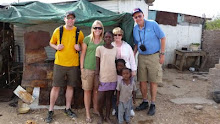
Nawrockis in Namibia Part IV: Visiting the Himba in Opuwo

We left Etosha and headed for Opuwo—a small town in the northern most part of the Kunene Region. While the place itself isn’t much to see, the people we met there made our visit memorable.

We stayed at the Ohakane Lodge on my friend Obie’s recommendation. He knows the owners and promised we’d be treated well. (We were.) Daniel, Angela, Celeste and Chindo took amazing care of us. They spent the early morning hours chatting away over cups of coffee and mugs of tea. And in the evening they prepared some Angolan specialties for us to sample. They were eager to share their knowledge of the place, its people and the Himba tribe with my family, who was equally eager to hear about it.


Celeste


Angela, Daniel and Chindo


Dad Teaching Chindo the "Obama Bump"


Me, Chindo and Chip

My parents also met Jeffie B and Ed, two fellow Peace Corps Volunteers.


We trekked to the top of a hill at the edge of town for dinner and drinks at the Opuwo Country Hotel—hands down the best view of sunset in Namibia.


Inside


Outside


Sunset

The following day we went on a tour of a Himba village about 50 kilometers outside of Opuwo.


The Village


The Chief


A Family Outside Their Home

The Himba are one of the last traditional tribes in Africa. While many of its people continue to live in the old ways, transitioning into the new world is proving attractive to some—particularly those who desire an education. Schools in Namibia do not allow the Himba to wear their traditional clothing in class. This means even those who prefer to live in the way of their grandfathers must adapt to contemporary styles Monday through Friday.

There’s now a mobile school that’s part of the Ministry of Youth seeking to change this practice by allowing Himba to wear their traditional clothing in class. But the movement is still in its infancy and because of strict dress codes in most places, many of the Himba do not attend school.


All but one of these girls were married. None were in school.


A Small Boy Carrying a Basket Between Homes


Three Teenage Girls from a Nearby Village


It was my family's first experience with the Himba. And while I’ve seen them walking the streets of Opuwo and selling their crafts to tourists in Outjo, this was my first time visiting a village and actually talking to the people. I was thankful to have Petrus as our guide. He was able to translate for us, which made communication much easier (most Himba don't speak English).

We walked away after four hours in the village with a greater understanding of the Himba tribe’s traditions—from the red ocher mixed with butter fat that women spread on their bodies, to the establishment of a village, which centers upon the chief and his many wives, the tour was a real education in the practices of a culture.


Greeting the Smallest Boy in the Village


An Elderly Woman Making Traditional Bracelets from Pounded Nails


This guy knew enough English to ask for my hand in marriage. But since he couldn't remember my name, I had to turn him down.


One of the Most Beautiful Women I've Met


Women Preparing to Sell Their Crafts

Wednesday, February 27, 2008

Something from Nothing

Hillside View of Opuwo

Back in the states a nine-hour car ride meant a trip from Michigan to Rochester, across the border and through Canada. It was a drive to Chicago and then some, or six trips from the city to the shore. It was legroom and traffic. Roadside stands and Top 40 Radio: windows rolled down and music turned up.

But here in Namibia the nine-hour car ride is a different animal entirely. It’s one that travels 12-deep with two screaming babies. It packs a variety of cooked (and stinking) meats for snacks, and includes two roadside breakdowns. It covers just 350 km. But on flooded out dirt roads, with Damara hymns blasting.

It leaves you wishing, more than anything, for transport of your own.

I spent the last week in Opuwo, the capital of the Kunene region, meeting with Ministry of Health officials and a Nam 26er who heads up the IEC (Information Education Communication) Committee for the region. It was supposed to help me learn more about the job I’m charged with doing over the next two years. After a month at site, Peace Corps (and my supervisor) must have finally decided it was time for a little direction. (Plus, it gave me an excuse to see some of Nam 27 friends and visit a new place, too.)

Twelve thousand people live in Opuwo, which makes it roughly twice the size of Khorixas. Though in the same region, the two places are dramatically different. Opuwo is built into a hillside with scenic views of Namibia—vast plains and towering plateaus. Mud hut settlements line the road into town, and Herero and Himba make up a majority of the population. Opuwo is "typical" Africa … what I imagined before coming to Namibia. The Himba women, with their traditional dress, red clay skin, intricate jewelry and exposed chests, look straight out of the pages of National Geographic.

The week felt like a second round of shadowing (which we did as trainees back in November). But this time it was job-specific. Kate, a Nam 26er who’s been working on IEC development in Opuwo for about six months, introduced us to the RMO (Regional Medical Officer), who explained what my job is for the next two yeas. We also went around to the regional Red Cross, Medicos del Mundo and a couple of other NGOs.

View from the Top

Kate has a western office, complete with a computer, scanner, printer and even air conditioning. It’s a far cry from the bare essentials (desk, chair, shelf) of my work space in Khorixas. Yet she and I are charged with the same task. In addition to general health promotion—community outreach, educational programs, demonstrations and program facilitation—we should both be developing educational and informational materials for our districts. The only difference is, she has the resources.

As I’m quickly learning, Peace Corps is an exercise in creating something out of nothing.

In addition to the obvious challenges presented by my non-existent access to technology, there are still more obstacles to bringing health messages to the masses. For starters, English is considered Namibia’s national language, but few people in Khorixas understand enough to grasp the complicated messages about HIV, diabetes and TB I’m trying to convey. And while most people here are fluent in Damara, it’s primarily an oral language. This means few are literate in their native tongue. Kate has relied on images alone for some of her most recent campaigns, but has come to realize that the western interpretation of pictures and stories is often very different from Namibian understandings and assumptions.

So it seems, I must build my place here from the ground up. I will need to solicit donations for a resource library for the hospital, so I can research the topics I am educating the community about. (It will also be good for nurses and doctors, who as of now, have no place to reference current medical studies or reports.) And I’ll need to find my own means of securing a computer, printer and scanner before I can begin to generate IEC materials. I'll also have to find local artists to create images for these brochures, posters and pamphlets. This is not to say the task is impossible. Rather, that it is, without a doubt, a process. One that reminds me of why we are here for two years.

I'm trying to move forward on this long-term project, but in the meantime, I’m focusing on the non-material production part of my job here: the health promotion and outreach. It's the part I expect to enjoy most.

I started Windows of Hope—a life skills, health and sexual education curriculum that’s sponsored by the Ministry of Education—on Monday. I’ll be teaching 40 grade-7 learners about HIV, sexuality, rape, relationships and their changing bodies. I’m continuing with Youth Leads, the after-school sports and leadership program with the SCORE volunteer, and planning for an Independence Day soccer and volleyball tournament for secondary school kids. I helped put together a Valentine’s Day event to promote HIV testing and spent the last few days in the field doing awareness campaigns. In May, Jessica and I will start our girls club, which will focus on self-esteem, self-respect, leadership and long-term goal setting for upper-primary learners.

I guess the good news about creating something from nothing is, there's always more to do.

Sunset in Opuwo